

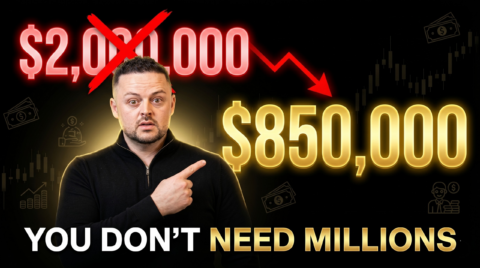

Most people spend their entire working life chasing one giant retirement number. $1 million. $2 million. $3 million. They assume that once they hit that number they can retire comfortably. But that assumption is missing the most important variable in retirement planning — not how much you have saved, but how much pressure you are putting on that savings every single month. Two retirees can live the exact same lifestyle while one needs nearly double the savings of the other. The difference is not luck. It is income structure.
Key Takeaways
- Retirement is an income problem not a savings problem
- The more dependable income you have the less portfolio you need
- Two retirees with the same lifestyle can need completely different portfolio sizes
- A single retiree at $10K/month with $2,600 Social Security needs ~$1.8M invested
- A married couple with two Social Security checks needs dramatically less from their portfolio
- Adding a pension or guaranteed income turns the portfolio into an opportunity bucket
- The income floor strategy eliminates the emotional stress of market volatility
- Dependable income matters more than chasing returns
The Real Retirement Question
Most people ask the wrong question about retirement. They ask: how much do I need to save? The right question is: how much pressure am I putting on my portfolio every single month?
There is a fundamental difference between having money invested and depending on investments to produce your monthly paycheck. The first is wealth. The second is a job you are assigning to your portfolio — and every dollar of lifestyle spending your portfolio is responsible for increases the size that portfolio needs to be.
The more pressure on the portfolio — the larger it has to become.
Single Retiree Scenario — $10,000 Per Month
Take a single retiree at age 65 targeting $10,000 per month — $120,000 per year. Assume Social Security provides approximately $2,600 per month, or roughly $31,000 per year.
The math is immediate:
$120,000 goal minus $31,000 Social Security equals $89,000 the portfolio must produce every year.
At a roughly 5% withdrawal rate that requires approximately $1.8 million invested. If you want to be more conservative that number climbs significantly.
This is where retirement starts feeling stressful for most people. The portfolio is no longer just growing wealth — it is responsible for paying your bills. Bad markets suddenly matter personally. Volatility becomes emotional. You never fully relax.
The Income Layering Strategy
What changes the math is not saving more. It is giving different portions of your money different jobs.
Instead of asking one giant portfolio to do everything all at once — create layers. One portion designed specifically for the first five years of retirement. Cash reserves, short-term income, safe money that helps you avoid force-selling during market downturns. The rest of the portfolio stays invested for the longer term.
With this strategy your growth portfolio has time to breathe. Time to recover. Retirement starts feeling far more stable — not just mathematically but emotionally.
Andrew has seen retirees with massive portfolios feel anxious every single day. And others with far less money sleep perfectly fine at night. The goal is not squeezing every ounce of return from your investments. The goal is dependable income without unnecessary stress.
Married Couple Scenario — The Same Lifestyle, Dramatically Different Math
Same lifestyle goal — $10,000 per month. But now there are two Social Security checks instead of one. $2,600 plus $2,600 equals roughly $62,000 per year.
Instead of the portfolio needing to cover $89,000 per year as in the single retiree scenario — it now only needs to cover approximately $58,000. A dramatic reduction in portfolio pressure. And because the pressure drops, the amount needed invested drops too.
This is why retirement planning can never be reduced to one magic number. Context matters. Income structure matters. Household structure matters. The more dependable income coming in before you touch your portfolio — the less vulnerable your retirement becomes to market swings.
Adding a Pension — When the Portfolio Becomes the Opportunity Bucket
Take that same married couple and add a reliable pension — military, public service, or another guaranteed income stream. Layer it on top of Social Security and suddenly most essential expenses are already covered before investments enter the picture.
This is the moment retirement truly feels different. The portfolio is no longer responsible for carrying the whole retirement plan. It becomes the supplement. The flexibility bucket. The opportunity bucket.
The people who feel the calmest in retirement are not always the people with the biggest portfolios. They are the people who built the strongest income floor. When your essential bills are already covered by dependable income — the market becomes far less scary. You stop watching every headline. You stop panicking at every correction. You stop feeling like your future depends on what happens next quarter on Wall Street.
Not All Spending Is Equal
Two retirees might both spend $10,000 per month — but one situation is far safer than the other. If half your spending is discretionary you have room to adjust when markets get rough. If nearly all of it is essential your plan has far less flexibility.
Flexibility is one of the most valuable assets you can have in retirement. It creates resilience. It creates options. It creates the ability to weather any storm without permanently damaging your retirement plan.
Designing an Unbreakable Income System
Retirement planning is ultimately about designing an unbreakable income system. One that protects your essentials, reduces stress, and allows you to actually enjoy retirement.
When someone asks how much they need to retire — the real answer is: it depends on how you build the income. The same lifestyle could require completely different portfolio sizes depending on income structure. And that is the retirement conversation most people unfortunately never hear.
If you would like help evaluating your own strategy — a free 15-minute Retirement Plan Clarity Session with Andrew Winnett, CFF is the right next step. Your retirement. Your situation. Your decision. No obligation.
Book your free Clarity Session → retirementrenegade.com/retirement-plan-clarity-session
Take legislative action today → ismymoneyprotected.com
Stream The Retirement Reset free — promo code CLARITY → retirementrenegade.com/the-retirement-reset
FAQs
It depends entirely on how your income is structured. Two people with the same lifestyle can need completely different portfolio sizes depending on how much dependable income they already have coming in before they touch their investments.
Separating your money into different jobs — one portion covering essential expenses through guaranteed income sources like Social Security, pensions, and guaranteed income streams, and the rest invested for growth. When your floor is covered your portfolio becomes the supplement not the source.
Because the amount your portfolio needs to produce depends on how much other dependable income is already covering your expenses. A married couple with two Social Security checks puts dramatically less pressure on their portfolio than a single retiree with one — even at the exact same monthly spending goal.
Every dollar of Social Security reduces the amount your portfolio must produce. A single retiree needing $10,000 per month with $2,600 in Social Security needs their portfolio to cover $89,000 per year. A married couple with two Social Security checks reduces that to $58,000 per year — the same lifestyle, dramatically less portfolio pressure.
The amount your portfolio is responsible for producing every month. The higher the pressure the larger the portfolio must be and the more vulnerable your retirement becomes to market volatility. Reducing portfolio pressure through guaranteed income sources is the most powerful thing you can do in retirement planning.
It removes a significant portion of essential expenses from the portfolio's responsibility entirely. Add a pension on top of Social Security and most of your core lifestyle is already covered before investments even enter the picture — turning your portfolio from a paycheck source into a flexibility and opportunity bucket.
A commonly used guideline suggesting you can withdraw approximately 5% of your portfolio per year in retirement without depleting it too quickly. At 5% a portfolio needs to be approximately $1.8 million to produce $89,000 per year. Reduce the income your portfolio must produce and that number drops significantly.
Layer your income sources — Social Security, pension if applicable, guaranteed income streams, and portfolio withdrawals. The more you can cover through guaranteed sources the less pressure on your portfolio. The goal is building a system where your core lifestyle is covered before your portfolio has to do any heavy lifting.
Income that arrives consistently regardless of what the market does — Social Security, pensions, annuities, and guaranteed income products. It matters because it eliminates the emotional stress of market volatility. When your essential bills are covered by dependable income the market becomes far less scary.
Build dependable income. Chasing returns in retirement puts unnecessary pressure on your portfolio and creates emotional stress every time the market moves. Confidence in retirement comes from knowing your core lifestyle is completely covered — not from achieving the highest possible return.
The portion of your portfolio that does not carry the pressure of essential lifestyle expenses. When your income floor is built and your essentials are covered by guaranteed sources your portfolio becomes the opportunity bucket — available for growth, discretionary spending, and legacy without the anxiety of depending on it to pay the bills.
Build an income floor that covers your essential expenses through guaranteed sources before you retire. When your core lifestyle does not depend on what the market does next quarter — you stop watching every headline, stop panicking at every correction, and stop feeling like your future depends on Wall Street.
A free 15-minute conversation with a Certified Financial Fiduciary. Your retirement. Your situation. What is protected and what is not. No obligation. Book a free Clarity Session at retirementrenegade.com/retirement-plan-clarity-session to understand the specific carve-outs available for your situation.
Ask your advisor how your plan performs in a bad first year of retirement. Ask how your income floor is structured if the market drops 30% the year you retire. If they cannot answer specifically — or have never stress-tested it — book a free Clarity Session at retirementrenegade.com/retirement-plan-clarity-session.
