
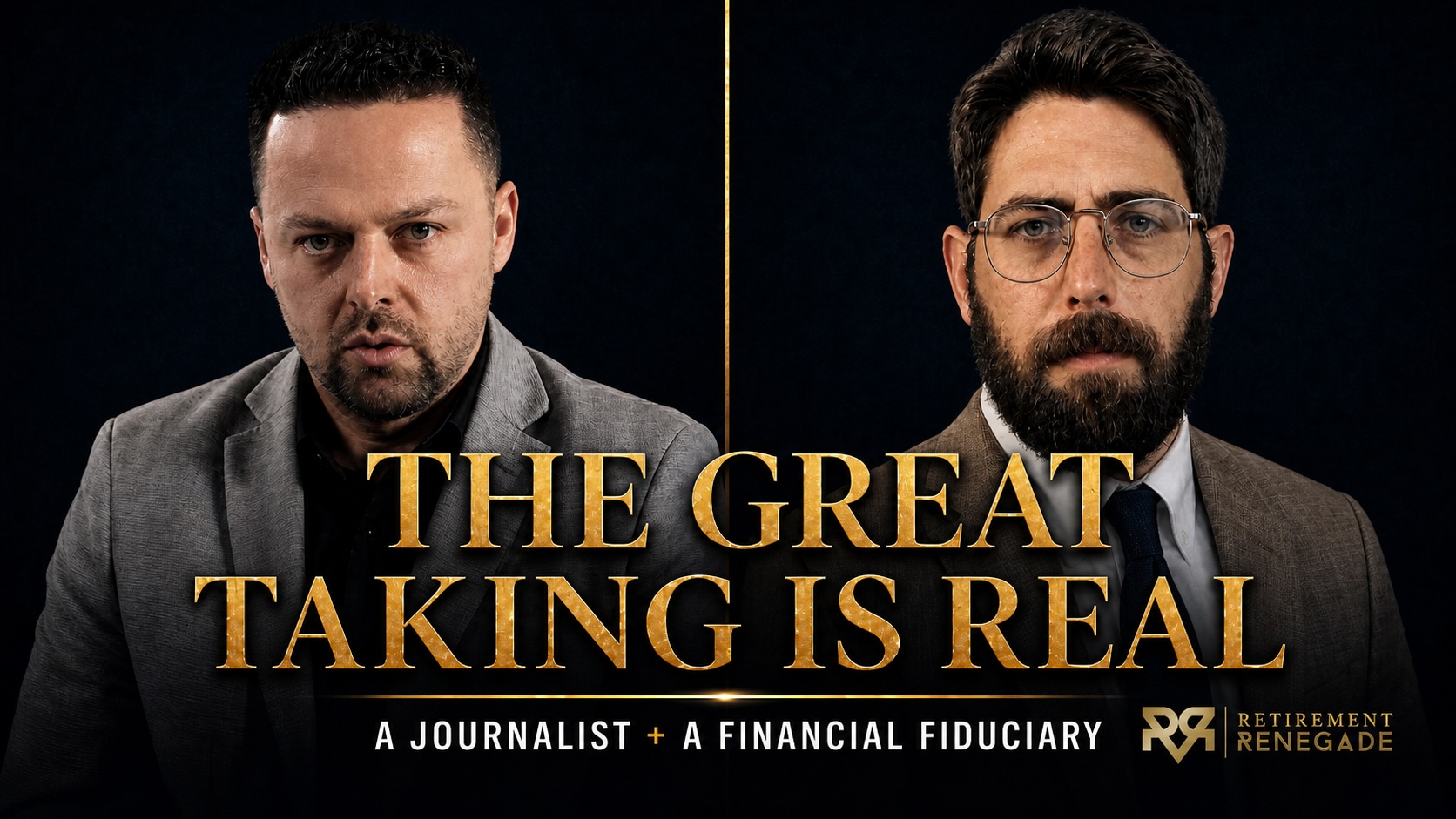

When investigative journalist Alex Newman first heard about The Great Taking—the idea that the laws governing your retirement accounts had been quietly changed to give banks legal priority over individual savers—his reaction was the same as most people’s. It sounded too bold. And yet, after months of independent investigation, he and I reached the same conclusion from completely different starting points. This article covers what we found—and what it means for your retirement savings.
Key Takeaways
- The laws governing retirement accounts have been changed in all 50 states under UCC Article 8
- Your IRA, 401k, and brokerage accounts are pooled through the Depository Trust Company—making you an entitlement holder, not a private property owner
- If your bank or custodian fails, they get paid back first—you get what is left
- This is not theoretical—it has happened over 100 times in American history
- Two independent investigators—a journalist and a financial fiduciary—reached the same conclusion from different starting points
- There are specific steps you can take right now to protect your accounts
What is The Great Taking?
The Great Taking refers to the legal framework—built into the Uniform Commercial Code, Article 8—that gives banks and custodians legal priority over individual retirement account holders in the event of insolvency. In plain language: if the institution holding your retirement savings fails, they get paid back first. You get what is left. In certain scenarios—nothing. The term was coined and documented by David Webb in his book of the same name, which traced how these laws were changed across all 50 states over several decades.
The Great Taking Explained: Alex Newman’s Moment of Conviction
Alex Newman has spent nearly 20 years covering institutional fraud, financial corruption, and the globalist agenda as an investigative journalist. When he first encountered The Great Taking concept, even he was skeptical.
The turning point came when researchers at one of the top conservative think tanks in America called him with a simple and devastating finding: they had actually read the laws in three Republican states and three Democrat states. And the laws had in fact been changed — exactly as David Webb documented.
In Alex’s words: “I thought, OK, this is actually a serious issue. I really need to dig into this.”
He got in touch with David Webb directly. He tracked down the lawmakers who were trying to change the laws back. And he reached a conclusion that surprised even him — someone who has spent two decades following the institutions most Americans have never heard of.
The Great Taking is real.
The Great Taking and UCC Article 8: Andrew’s LAX Discovery
When a journalist who has spent 20 years documenting institutional fraud and a financial fiduciary who has spent 17 years protecting retirement savings both independently investigate the same issue and reach the same conclusion — that is not a conspiracy theory. That is two professionals following evidence to the same destination from completely different starting points.
That destination is this: under UCC Article 8, the money in your IRA, your 401k, and your brokerage account is not legally yours the way cash in your wallet is. When you give a bank or custodian your money, it becomes pooled through the Depository Trust Company. Once pooled, you are no longer the private property holder. You are what is called an entitlement holder.
As long as your custodian stays solvent — everything is fine. But if they don’t, the institution gets paid back first. You get what is left. In certain situations: nothing.
This is not theoretical. It has happened over 100 times in American history. The most documented example was Lehman Brothers — where accounts were frozen for 14 years and 13 days.
For a deeper look at how custodian risk affects your retirement accounts, read are retirement accounts protected from bank failure.
Why The Great Taking Isn’t More Widely Known
If this legal framework exists and has been tested in court — why don’t more people know about it?
The answer comes down to two things: awareness and incentives.
Most financial advisors either don’t fully understand the structural risk or avoid the topic because it creates fear and uncertainty — both of which can disrupt client relationships and impact the fees they earn. There is also a broader normalcy bias at work: everything has been fine, markets have gone up, portfolios have grown — so the assumption becomes that this will continue indefinitely.
That assumption is dangerous. And it is exactly the assumption The Retirement Reset was made to challenge.
Should You Be Concerned About Your Retirement Accounts? You May Not Hear
The honest answer is: yes—but not in a way that should paralyze you. Concern without action is just anxiety. The point of understanding The Great Taking is not to frighten you but to give you the information you need to protect what you have built.
There are specific, legal, practical steps you can take right now. Most advisors either don’t know about them or won’t bring them up. That is why we built ismymoneyprotected.com—so every person watching this has access to the same resources regardless of who their advisor is.
Final Thoughts on The Great Taking
The core message is not that every financial advisor is corrupt or that your money will definitely be taken. It is that the legal framework exists, it has been used before, and most Americans have no idea it applies to their retirement accounts. Understanding it is the first step. Acting on it is the second.
If you want to understand how your specific accounts are protected, structured, and what a protected retirement plan looks like for your situation—a free Retirement Clarity Session is the right next step. 15 minutes. No obligation. Just clarity.
FAQs
A legal framework that gives banks priority over your retirement savings if they fail.
It's the law that changed your status from property owner to entitlement holder.
It's documented law—tested in court over 100 times in American history.
A property owner owns the asset outright. An entitlement holder gets what's left after the institution is paid.
The New York-based company that pools all retirement securities from 800+ banks and custodians.
Under the current legal framework—yes, if your custodian fails.
Their accounts were frozen for 14 years and 13 days. Some were never made whole.
Yes—over 100 documented times. Conservatively tens of billions of dollars taken.
That the laws had been changed in all 50 states exactly as David Webb documented.
The same conclusion—irrefutable legal evidence that your retirement savings are vulnerable.
There are specific legal carve-outs—a Clarity Session will show you exactly what applies to your situation.
A free resource we built with legislator maps, email templates, and phone scripts to take action in under 10 minutes. To help you help us take action.
Yes and you should be informed—informed people can act. Uninformed people can't.
Always—especially if your advisor has never mentioned UCC Article 8.
A free 15-minute conversation with one of our advisors about your specific situation. No obligation.
