


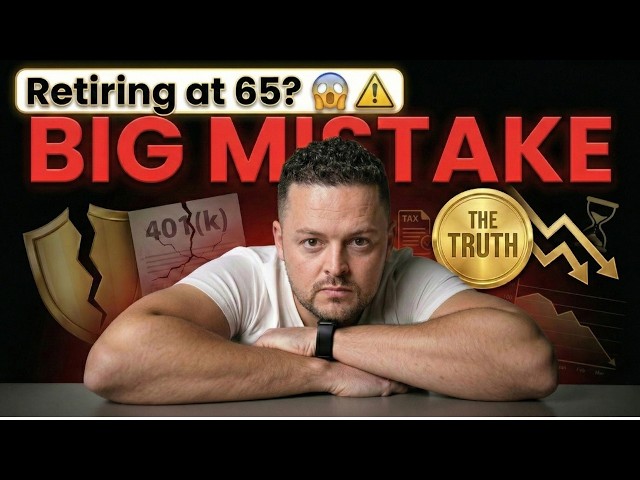
Retiring at 65 sounds like the safe move. It sounds responsible. It sounds like the age you’re supposed to aim for. But this message pushes back on that idea hard. The argument is simple: waiting longer is not always protecting your future. Sometimes it is costing you time, health, flexibility, and peace of mind while someone else keeps collecting fees from money that stays in the market.
Key Takeaways on Retiring at 65
- Traditional retirement advice may keep people working longer than they need to.
- The transcript argues that some advisors benefit when clients delay retirement because their business model is tied to assets under management.
- Retirement is framed here as a financial position, not just an age.
- Reliable income matters more than watching a portfolio rise and fall with the market.
- Waiting can mean giving up years of better health and a more active lifestyle.
- The message emphasizes protecting what you built from inflation and market crashes.
- The goal is peace of mind through income you can count on for life.
What is retiring at 65? In this transcript, retiring at 65 is not treated as an automatic milestone or a default win. It represents the conventional timeline many people are told to follow, even when their expenses may already be coverable by dependable income. The point is that retirement should be based on secured lifestyle income, not just reaching a commonly accepted age.
Why the Traditional Retirement Age Gets Challenged
 The opening claim is blunt: most financial advisors are trained to keep you working longer than you need to. Why? Because, according to the transcript, their business model is built on 1% of your assets. The longer your money stays in the market, the longer those fees keep coming. That means delay is not neutral in this framing. Delay benefits someone.
And that leads to the real question in the video: what are you actually waiting for? Another market cycle? Another stressful year? Another stretch of watching headlines and hoping your plan holds up?
The transcript says people are often told to wait until 65 or 67, but it argues that healthy life expectancy tells a different story. By 67, the “active window” starts to close. The decline phase, as the speaker puts it, is not a theory. It is a statistical reality. The message is not subtle. You may gain more years on paper, but lose years that feel fully usable.
Retiring at 65 Is About More Than Hitting a Number
This is where the transcript pivots away from account balances and into outcomes. Most advisors, the speaker says, focus on the number. But you cannot eat a portfolio. That line captures the whole message. A portfolio might look impressive, but your day-to-day life runs on income, not on a statement.
The argument is that retirement should not depend on whether the market is having a good month or a bad one. You need predictable, reliable income. You need a foundation. You need something you can count on regardless of what the headlines say.
That is why the video presents a “new retirement model” that is not about chasing returns. It is about securing outcomes. Not maybe. Not hopefully. Outcomes you can count on.
There is a clear emotional contrast here. One model leaves your lifestyle tied to volatility. The other gives you a monthly sense of certainty. The speaker asks you to picture waking up knowing exactly what is coming in every month. That image matters because it turns retirement from a market question into a lifestyle question.
Why Waiting Can Cost More Than It Looks Like
One of the strongest lines in the transcript is that if you retire now, they lose five years of fees. The speaker then reframes that as five years of your life they are quietly trying to buy. That is not presented as a technical planning issue. It is presented as a values issue.
Time is the real currency here. Money is a tool. You can always make more money, the speaker says, but you can never buy back 62. That line drives the whole point home. Waiting may improve a spreadsheet, but the transcript challenges whether it improves your life.
Is an extra half million at 70 worth giving up eight years of your best health? The speaker says the math does not add up. That is not a detailed numerical case study. It is a challenge to the usual assumption that more accumulation always equals a better retirement.
There is also a legacy angle. True legacy planning, according to the transcript, starts with making sure you are never a burden to the people you love. That means you need a floor, not just a ceiling. You need something stable underneath you, not only upside above you.
Market Risk, Inflation, and the Need for a Floor
 The speaker says you spent decades building your assets. Now the priority is to protect them from inflation and market crashes. That framing shifts retirement planning away from growth-first thinking and toward protection-first thinking.
That concern lines up with the risk of relying too heavily on portfolio withdrawals during unstable markets. For more on that side of the conversation, see this explanation of sequence of returns risk in retirement.
The transcript does not say growth is irrelevant. It says growth alone is not enough. A plan that rises and falls with the market may still leave too much uncertainty around your actual lifestyle. If income is the goal, then the floor matters. If peace of mind is the goal, then predictability matters. If independence is the goal, then the source and stability of income matter just as much as the size of the account.
The speaker also says a smarter model grows wealth without a constant tax drag. The transcript does not expand that point with tactics or examples, but it does make the broader claim: keeping more of what you have matters just as much as growing it.
What Retirement Really Means in This Message
Retirement is not an age. That may be the core definition in the video. The speaker defines it as a financial position where your expenses are covered by income you cannot outlive. That is a major shift from the usual conversation.
So what does that mean in plain language? It means the calendar is not the final decision-maker. Your ability to cover expenses with dependable income is. The transcript argues that this is the more useful standard because it ties retirement to function, not tradition.
That also explains the repeated emphasis on certainty. A portfolio can fluctuate. Headlines can change. Washington can change. Wall Street can change. But the desired outcome in this framework is a lifestyle that stays secured anyway.
What are you really waiting for if your lifestyle can already be secured?
The Core Tradeoff the Transcript Wants You to See
The message is not merely “retire early.” It is more pointed than that. It is “do not delay just because delay has been normalized.” The speaker wants the audience to question who benefits from that delay and what they are giving up in return.
If waiting means more fees for someone else, more exposure to market swings, more stress, and fewer years in better health, then the transcript argues that the default advice deserves scrutiny. The appeal here is not just financial. It is personal. It is emotional. It is about control.
That is why the speaker keeps bringing the conversation back to peace of mind, dependable income, and true financial independence. Not theoretical wealth. Not a someday number. A plan that supports life now and later.
A Different Way to Think About the Next Step
 The transcript says the company has developed a three-step process to help bridge the gap between working and true financial independence. It does not break down the three steps in this clip, so the takeaway is not the mechanics. The takeaway is the purpose: closing the distance between earning a paycheck and living on income you can rely on.
The final message is clear. Waiting is a choice. Every day you delay is another day you may be sacrificing your most precious resource. That resource is not your balance. It is your time.
If you want to hear the full argument in the speaker’s own words, Watch the full video on YouTube. For broader retirement planning resources, you can also review retirement planning resources.
Book your free 15-minute strategy call. The link is right below the video. This is presented as the chance to see how close you really are to securing the kind of retirement the transcript describes.
