


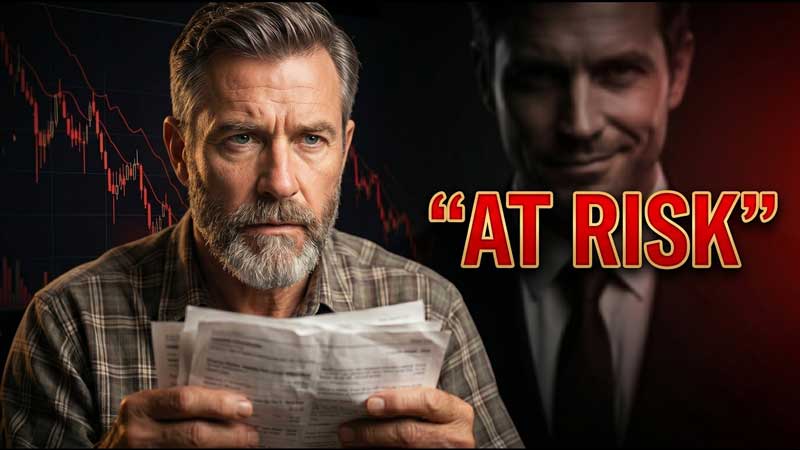
When it comes to what advisors don’t tell you about money, the reality can feel uncomfortable. Most people assume their financial advisor is giving them the full picture—but that may not always be the case. According to the perspective shared here, many advisors operate with a built-in optimism that everything will continue working the way it always has. And that assumption alone can create serious blind spots for your financial future.
Key Takeaways
- Many advisors operate with a “normalcy bias,” assuming markets will remain stable.
- Advisors may avoid negative outlooks to protect their business model and fees.
- There are concerns about systemic risks, including a potential major economic downturn.
- Bank and custodian structures may put your money at risk in failure scenarios.
- Legal frameworks like the Uniform Commercial Code can prioritize institutions over individuals.
- Getting a second opinion on your retirement strategy may be worth it.
What is what advisors don’t tell you about money? It refers to the idea that some financial professionals may not openly discuss potential risks, negative scenarios, or structural issues that could impact your savings—especially if those conversations conflict with their business model or long-term client retention.
What Advisors Don’t Tell You About Money and Market Optimism
 One of the biggest themes is what’s called “normalcy bias.” The idea is simple: if things have been good, people assume they’ll stay good. Many advisors, according to this viewpoint, fall into this pattern.
Everything has worked. Markets have gone up. Portfolios have grown. So the expectation becomes that this trend will continue indefinitely. But the concern raised here is that this mindset can be dangerous—especially if it prevents honest conversations about risk.
Why would that happen? Because challenging that narrative could disrupt the relationship. It could cause clients to question strategies, move money, or even step away entirely.
Why Advisors May Avoid Hard Truths
The transcript points to a core issue: incentives. Advisors often manage assets and earn ongoing fees. That creates a situation where stability is rewarded—and disruption is not.
If a client becomes worried and decides to move assets into cash or change strategies significantly, that can directly impact the advisor’s income. So there’s a natural resistance to “rocking the apple cart.”
This doesn’t necessarily mean bad intent. But it does suggest that certain conversations—especially negative or uncertain ones—may not always happen as openly as they should.
Concerns About a Major Economic Downturn
Another key point raised is the belief that a major economic downturn is not only possible, but inevitable. The speaker suggests that factors like demographics and national debt are contributing to a situation that cannot be avoided.
Whether or not someone agrees with that outlook, the important takeaway is this: if your strategy assumes everything will always improve, you may not be prepared for the opposite scenario.
That raises an important question: Are you positioned only for growth, or also for disruption?
Bank and Custodian Risk: What You May Not Hear
 This is where the conversation becomes more specific—and more concerning. The transcript highlights risks tied to how accounts are structured within banks and custodians.
According to this perspective, legal frameworks like the Uniform Commercial Code (UCC), particularly Article 8, may prioritize financial institutions in the event of failure. That means if a bank or custodian becomes insolvent, they may be first in line to recover funds—while account holders are last.
For a deeper look at this issue, you can read are retirement accounts protected from bank failure.
The claim is that this risk is not widely discussed and is often dismissed. Yet, examples are cited where funds have been lost or restricted in past scenarios.
Why This Conversation Isn’t More Common
If these risks exist, why don’t more people talk about them?
According to the transcript, it comes down to awareness and incentives. Some advisors may not fully understand these structural risks. Others may avoid the topic because it creates fear or uncertainty—both of which can disrupt client relationships.
There’s also the idea of a broader “marketing machine” that reinforces confidence in the system. When everything appears stable on the surface, it’s easy for deeper concerns to go unexamined.
Should You Get a Second Opinion?
One of the most practical takeaways is simple: if your concerns are dismissed or minimized, it may be worth seeking another perspective.
Your retirement savings represent years—sometimes decades—of work. Taking 15 minutes to get a second opinion could help you see risks or strategies you hadn’t considered.
At the very least, it gives you more information. And when it comes to your financial future, more clarity is rarely a bad thing.
Final Thoughts on What Advisors Don’t Tell You About Money
 The core message isn’t necessarily that every advisor is wrong or withholding information. It’s that incentives, assumptions, and system structures can shape what gets discussed—and what doesn’t.
Understanding what advisors don’t tell you about money means being willing to ask harder questions, explore uncomfortable scenarios, and take a more active role in your financial decisions.
If something feels off—or simply incomplete—it may be worth digging deeper.
learn about retirement benefits
Watch the full video on YouTube
If you want to better understand your situation or explore your options, consider reaching out and getting a second opinion on your current strategy.
